
Donate
Help them make the trip
A monarch born in Ontario this summer may fly more than 3,000 kilometres to a forest it has never seen. Your gift helps the people who plant milkweed, count monarchs and protect those forests.
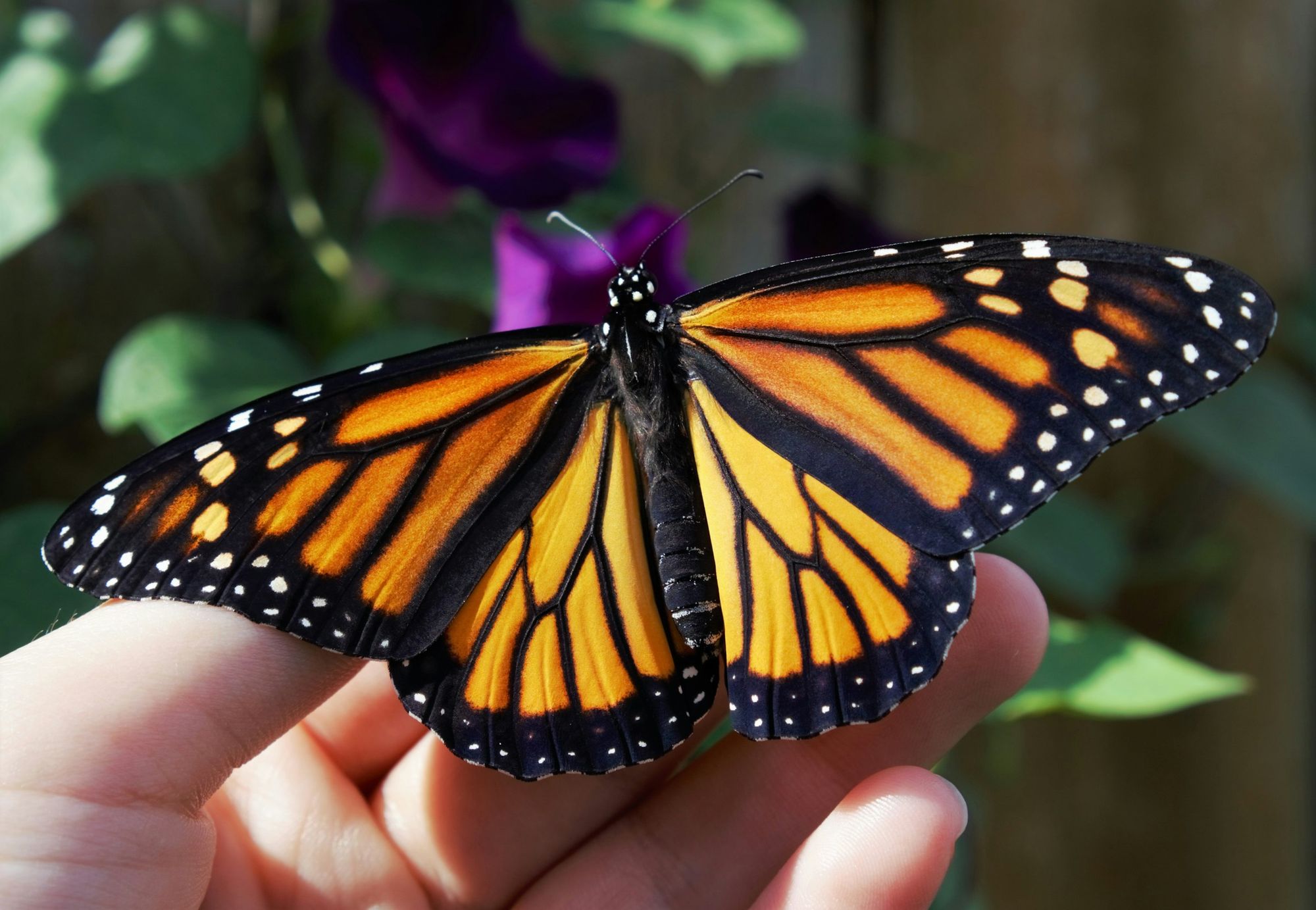
Danaus plexippus a light landing
While you are here
Monarch field notes
- Fun fact
The monarch leaving Ontario this fall has never seen Mexico. It is the great-grandchild, or great-great-grandchild, of the monarchs that left those forests last spring.
Source: Monarch Joint Venture
Watch the journey - Fun fact
A monarch weighs less than a gram.
Source: Xerces Society
See how they are tracked - Fun fact
The radio tags that now follow single monarchs weigh 60 milligrams: less than a tenth of a gram.
Source: Xerces Society, 2025
Follow one monarch - Fun fact
The farthest one monarch was estimated to fly in a single day is 143 kilometres, with help from the wind.
Source: Gibo 1981, Canadian Journal of Zoology
Fly the line - Fun fact
In winter, a patch of Mexican forest a tenth of a hectare in size holds an estimated 2 million monarchs, packed onto the branches.
Source: Thogmartin et al. 2017, PeerJ
Fill the forest - Fun fact
A monarch cruises at about 17.6 km/h. A strong headwind can blow it backward, so monarchs wait on the shore for the wind to turn.
Source: Urquhart 1960, in Brower et al. 2006; Parks Canada
Ride the wind - Fun fact
Monarch caterpillars eat only one kind of plant: milkweed.
Source: Monarch Joint Venture
No milkweed, no monarchs - From our data
In Ontario, the first monarch eggs show up about two weeks after the first adults, around the first week of June.
Source: GBIF records, Ontario, 2016 to 2025
See the Ontario year - From our data
People in Canada have reported more than 16,000 monarch eggs, caterpillars and chrysalises. Most were found in Ontario.
Source: GBIF records, all years
Where they breed - Garden tip
Hold off mowing milkweed from June to August. That is when the eggs and caterpillars are on the leaves.
Source: Ontario breeding season, GBIF records
More ways to help - Garden tip
Leave asters and goldenrod blooming in September. The migrating generation needs that nectar for the trip to Mexico.
Source: Brower et al. 2006
Plant for monarchs - On this site
Every chart here uses real records. The Journey alone maps more than 386,000 monarch sightings from 2016 to 2026.
Source: GBIF.org
Open The Journey
Make a gift
Choose an amount, then add your details. Every gift goes to monarch work.
Where your gift goes
What a gift does
01
Milkweed in the ground
Partners plant native milkweed and fall flowers in parks, farms and schoolyards, where monarchs can raise the next generation.
02
Eyes on the monarchs
Community science programs train volunteers to count eggs, caterpillars and butterflies. Their counts become the data on this site.
03
Safe winter forests
Groups in Mexico and beyond protect the mountain forests where eastern monarchs spend the winter.
A monarch weighs less than a gram. Every fall it carries that weight, and the future of its kind, thousands of kilometres.
Questions