
Data story 01 · Population
Two populations, thirty winters
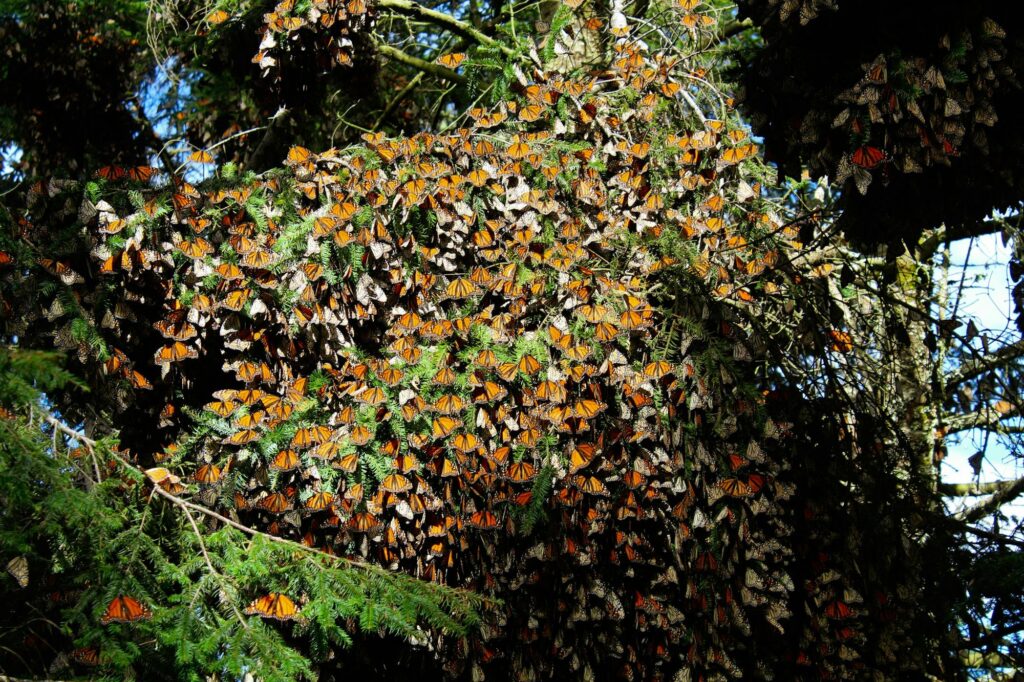
North America has two big groups of migrating monarchs. Eastern monarchs, including ours from Ontario and Quebec, spend the winter in the mountain forests of Mexico. Western monarchs spend it on the California coast. Scientists and volunteers have measured both every winter for about thirty years.
Read it right
Every chart has limits. Here is what this one can tell you, and what it cannot.
What this shows
- Eastern forest, every winterHow much Mexican forest the eastern colonies covered, from 1993-94 to 2025-26.
- Western count, every NovemberHow many western monarchs volunteers counted on the California coast, from 1997 to 2025.
- Both far below the 1990sLast winter the eastern colonies covered about half the forest they did in 1997-98, and the western count was about 1% of its 1997 total.
What it does not show
- An exact number of monarchsThe eastern figure is forest area. Scientists estimate how many monarchs fit in a hectare, and those estimates vary a lot.
- Why the numbers changedHabitat loss, weather and pesticides are all studied causes, but this chart does not separate them.
- Monarchs that do not migrateThey are not part of either count.
Sources. Eastern colonies: WWF-Mexico and CONANP surveys, compiled by Monarch Watch. Western count: Xerces Society Western Monarch Count. 1993-94 is shown as measured (6.23 ha); Monarch Watch notes about 7.75 ha once colonies not measured that year are added. The narrated tour is read by an AI voice (OpenAI gpt-audio, via OpenRouter) from the captions you see. See Data and credits. No endorsement implied.